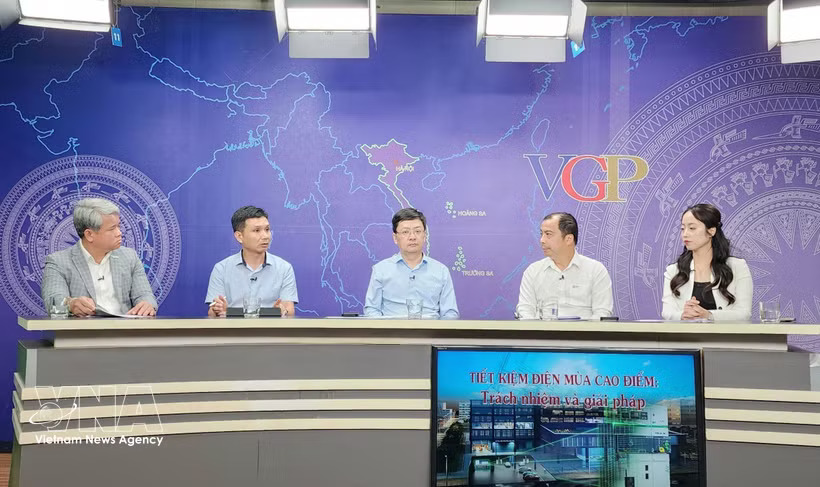
Delegates at the seminar on June 22 (Photo: VNA)
Experts at a seminar on June 22 called for stronger efforts to promote efficient electricity use as a key solution to ensure national energy security amid rapidly rising power demand and growing challenges to the sector.
Speaking at the seminar, held by the Government Portal, Dang Hai Dung, Deputy Director of the Agency for Innovation, Green Transition and Industry Promotion under the Ministry of Industry and Trade (MoIT), said Vietnam’s power system has recently recorded a peak load exceeding 58,000 MW, while daily electricity consumption has surpassed 1 billion kWh on some days.
With Vietnam targeting double-digit economic growth in the coming years, electricity demand is expected to rise sharply, posing growing risks and challenges, he noted.
The biggest risk, he said, stems from global geopolitical instability, which could disrupt energy supply chains and put pressure on business operations and the broader economy.
At the same time, requirements related to green taxes, carbon emission reductions, the Carbon Border Adjustment Mechanism (CBAM) and the Green Deal are increasing pressure on the country’s energy transition, he stressed.
As a result, Vietnam must raise the share of renewable energy in its power mix, although doing so will make power system forecasting and operation more complex due to the greater dependence on weather conditions.
Dung said the Government and the MoIT are implementing a range of measures, with energy efficiency identified as a key pillar. The Prime Minister has issued directives promoting rooftop solar power and improving power system efficiency, while time-of-use electricity pricing is expected to be introduced more widely.
Dang Nguyen Ngu, General Director of Schneider Electric Vietnam and Cambodia, stressed that a stable electricity supply is a major factor in attracting investment, noting that reliable power is among the top considerations for global investors selecting locations for data centres. National energy security, he said, has become a competitive advantage and a strategic lever for drawing foreign direct investment.
Dung said the Government now requires state agencies and businesses to develop energy-saving plans, set key performance indicators (KPIs) on energy efficiency, establish energy consumption benchmarks, and tighten technical standards and regulations in production and export.
Regarding technology transfer, Dung said support programmes will be developed to help businesses identify energy waste and assess their energy-saving potential. He added that networks of energy management or consultancy will be formed, connecting businesses seeking to improve energy efficiency with technology providers and organisations offering technical solutions and support tools.
The MoIT is also drafting a proposal to establish an energy efficiency fund, which is expected to provide technical assistance and financial support to help businesses upgrade technologies and improve energy efficiency, he said.
Meanwhile, Ngo Son Hai, Deputy General Director of Vietnam Electricity (EVN), stressed that saving electricity is key not only to cutting costs but also to strengthening energy security and supporting sustainable development. As electricity demand requires an additional 4,000–5,000 MW of new capacity each year, energy conservation is essential to easing investment pressure on the power sector.
To add 1,000 MW from offshore wind or LNG power projects, it typically takes three to four years after completing all procedures before they can become operational. Meanwhile, saving just around 2% of electricity demand wil already reduce the need for about 1,000 MW of new investment, Hai said, underscoring that energy conservation is a faster, more effective and far less costly solution.
He also recommended practical measures for efficient electricity use, suggesting households set air conditioners at around 26°C, limit cooling losses by keeping doors and windows closed, and carry out regular inspection and maintenance.
Noting that EVN has developed tools allowing consumers to track their daily electricity consumption, but that not many people actively monitor these figures, Ha Dang Son, Director at Centre for Energy and Green Growth Research, stressed that measurement, assessment and data monitoring are essential to understand consumption patterns and to ensure effective energy saving./.
VNA
Share