In previous years, rooftop solar power in Ho Chi Minh City was mainly viewed from the perspective of reducing electricity costs for households and businesses. In the context of rising energy demand and increasing pressure from green transition and emissions reduction requirements, the role of this power source is gradually changing.
A series of “mini power plants” spread across tens of thousands of rooftops
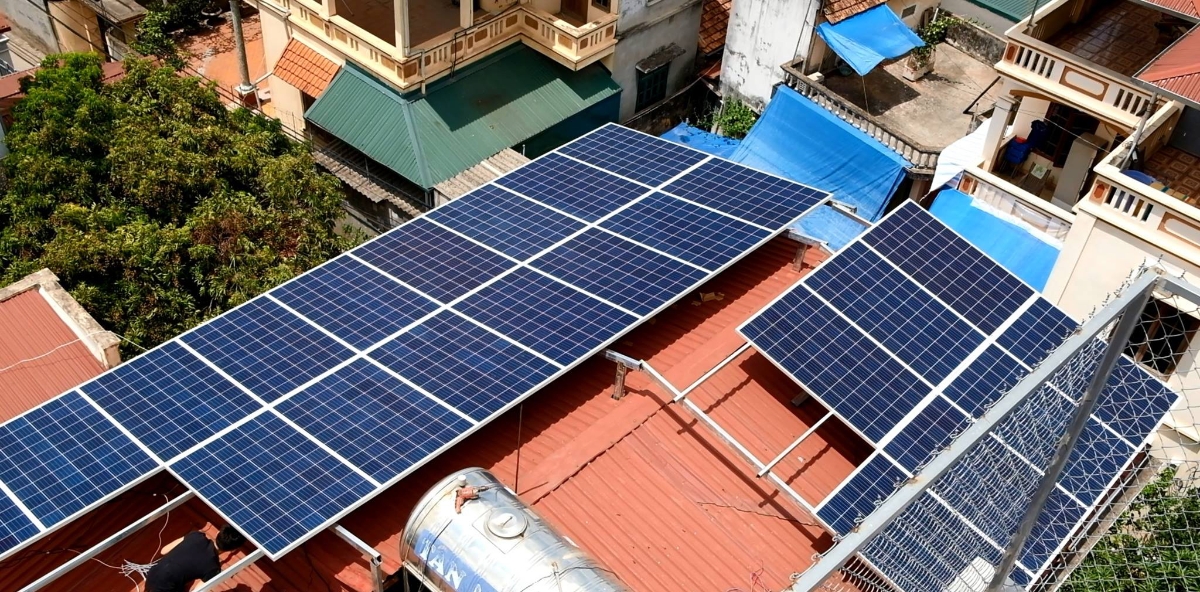
There remains significant potential for rooftop solar power development in Ho Chi Minh City
According to data announced by the Ho Chi Minh City Department of Industry and Trade at the seminar “Ensuring Energy for Ho Chi Minh City’s Double-Digit Growth Target” held on 5 May 2026, Ho Chi Minh City currently has approximately 22,355 installed rooftop solar power systems, with a total capacity of about 1,832MWp. Meanwhile, other updated statistics from Ho Chi Minh City Power Corporation (EVNHCMC) show that by the end of the first quarter of 2026, the city had approximately 22,778 rooftop solar systems connected to the power grid, with a total capacity of about 1,856MWp.
When compared with the development scale of power generation sources, this capacity is equivalent to that of many large-scale power generation projects currently in operation. Notably, this power source is not concentrated in a single location but is distributed across tens of thousands of residential rooftops, factories, shopping centers, office buildings, schools, and production facilities.
Energy experts believe that this is a form of distributed generation, a trend that many countries are promoting in order to reduce pressure on investment in centralized power sources, minimize transmission losses, and enhance the flexibility of power systems.
According to EVNHCMC, rooftop solar power helps reduce transmission pressure on the power grid, especially during daytime peak-load hours, limits localized overloading in areas with high electricity demand density, and contributes to improving the reliability of electricity supply while reducing power losses.
The Ho Chi Minh City Department of Industry and Trade stated that there are currently about 559 investors implementing self-production, self-consumption rooftop solar power models without selling electricity to the grid, with a total capacity of approximately 48.55MW. This is considered a sign that awareness of clean energy use and proactive electricity supply is gradually changing among businesses and residents.
At the end of May, the Ho Chi Minh City People's Committee issued a plan on strengthening electricity-saving measures and promoting rooftop solar power development throughout the city (Plan No. 236). Under the plan, the target is for approximately 10% of households and 10% of public agencies to install self-production, self-consumption rooftop solar power systems each year. If this target is maintained over many years, the scale of distributed power generation across the city will continue to expand significantly.
When green energy becomes a competitive advantage
According to the assessment of Ho Chi Minh City’s power sector, the potential for rooftop solar power development in this “mega-city” remains substantial, particularly in industrial parks, export processing zones, commercial buildings, and urban infrastructure facilities.
From a medium-term perspective, as battery energy storage systems (BESS) are deployed more widely, the ability to utilize on-site solar power will continue to improve, helping reduce demand pressure during evening peak-load hours. Therefore, rooftop solar power is gradually being viewed not only as an environmental solution or a means of reducing electricity costs.
In the long term, it may become a component of the urban energy security strategy, while also serving as one of the factors supporting Ho Chi Minh City’s competitiveness in its next stage of development.
In the race to attract investment, develop the digital economy, and advance the green transition, clean energy is increasingly becoming part of the development infrastructure, similar to transportation, logistics, and data infrastructure. Along this journey, tens of thousands of rooftops are creating a source of green electricity whose significance for the future of Ho Chi Minh City continues to grow.
Translator: Vân Ly
Share