The Nong Cong 220kV substation, operational since 2017, is a crucial node on the national power transmission grid, responsible for supplying power to Thanh Hoa province and surrounding areas. From its initial construction, the substation was designed with a remote control model, integrating a modern control and monitoring system to optimize operating personnel and enhance the reliability of power supply.
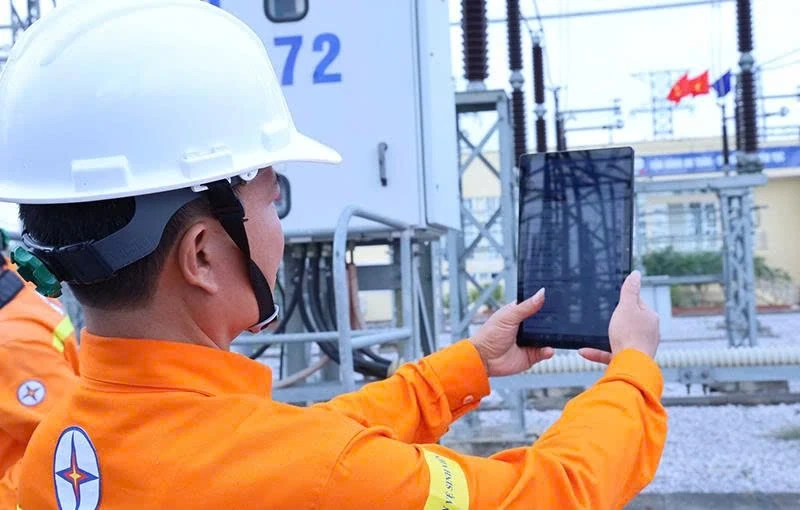
At Nong Cong 220kV Substation, parameter monitoring is performed using tablets for instant access to technical data.
All equipment in the substation is connected and monitored through a computer system in the central control room, and is also linked to the power system dispatch centers. Equipment inspections are performed using tablets, allowing quick access to technical parameters and the operating history of each device via QR code. This method shortens inspection time and minimizes errors during operation.
Technology is being applied extensively not only at substations but also in the management of transmission lines. With over 1,100km of 220kV and 500kV lines traversing many complex mountainous areas, the use of UAVs and modern monitoring tools has helped the unit improve the efficiency of power grid inspections.
UAVs are equipped with optical cameras, thermal imaging cameras, and specialized sensors, allowing for detailed inspection of locations on top of poles, conductors, and accessories - areas difficult to access with manual observation. This enables early detection of abnormalities such as overheating contact points, equipment damage, or violations of the transmission line corridor, contributing to reduced accident risk and ensuring operational safety.
According to Thanh Hoa Power Transmission Company (THPTC), in addition to UAVs, many modern monitoring devices, such as UV intensity meters and thermal imaging cameras, are also regularly used. These tools help to detect early signs of heat generation, localized discharges, or signs of insulation degradation, thereby shifting the inspection method from passive to proactive, from incident handling to risk prevention.
The operational management workload of THPTC is also increasing. Currently, the unit manages 5 220kV substations and 2 500kV substations with a total capacity of approximately 2,100MVA; the total length of 500kV lines is over 556km, and 220kV lines is nearly 578km.
In 2025, the total power transmission through the system is expected to reach nearly 29.8 billion kWh; the load supplied to Thanh Hoa province alone will surpass 9.7 billion kWh. These figures demonstrate the increasing scale of operation and the growing pressure on power supply in the context of continuously rising demand for electricity to serve economic development.
According to the plan, by 2026, the unit aims to expand the application of technology in operational management, in which the entire power line route will be inspected using UAVs combined with LiDAR scanning and the creation of automated flight path data. At that time, periodic inspections will be mainly carried out using technology, minimizing manual labour and improving the ability to predict incidents.
The application of technological solutions in transmission grid operation not only contributes to improving management efficiency but is also a crucial step in the modernization of the power system, meeting the requirements for safe and stable power supply in the context of continuously increasing load demand.
Translator: Nguyễn Thị Lan Anh
Share