Innovating approaches to enhance governance and operational efficiency
Since 2021, EVN has implemented the “Master Plan for Digital Transformation at Vietnam Electricity through 2022, with a Vision to 2025,” in accordance with Resolution No. 68/NQ-HĐTV dated February 17, 2021, issued by EVN’s Board of Directors. The plan covers five areas: internal governance; investment and construction; power generation; business and customer services; and telecommunications and information technology.
Through its implementation, EVN has digitized 532 core business processes and independently researched and developed 26 shared software systems. These applications have been integrated into daily operations in various areas, including document processing, human resources, finance, technical management, and investment and construction.
According to the report on plan implementation, EVN officially adopted the digital enterprise model and began operating under this model in January 2025.
For internal management, the Digital Office system has been deployed across all EVN units. All reports are circulated electronically, and managers have been issued digital signatures; 95% of outgoing documents are digitally signed, while 99.5% of incoming documents are handled electronically.
Managing the submission, issuance, receipt, and archiving of records in a digital environment reduces document circulation time and facilitates information retrieval and collaborative processing. Alongside digitalization, EVN’s units have reviewed and streamlined procedures and standardized forms to ensure seamless workflows.
During the 2021–2025 period, the Smart EVN application was integrated with more than 10 internal systems across EVN, bringing together various tools to support daily operations. Through both web and mobile platforms, employees can access information and complete multiple procedures within a single application, saving time on administrative tasks.
Leadership and management are also supported by an intelligent reporting system that automatically retrieves data from shared software systems.
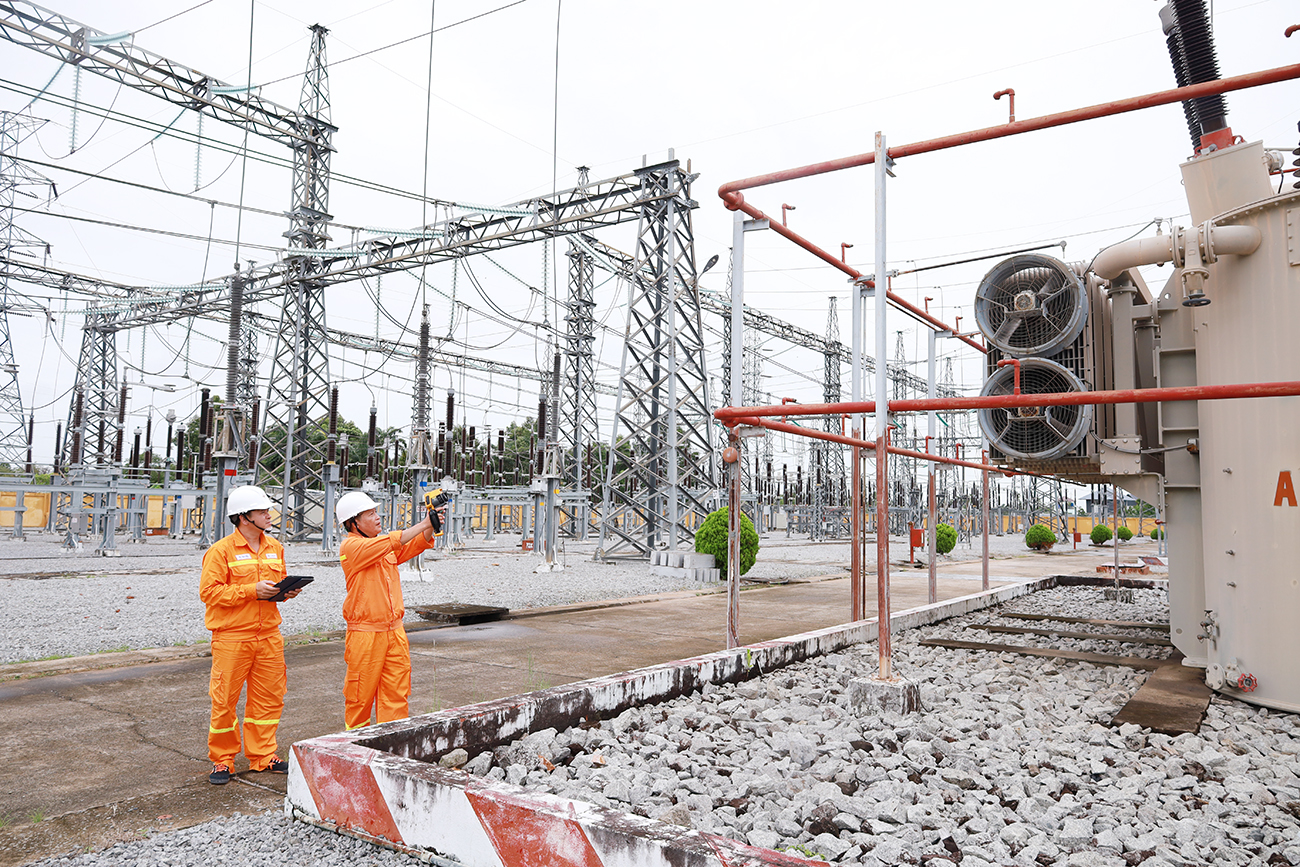
EVNNPT staff utilizing modern equipment to inspect and monitor status of assets at substation.
In power grid management and operation, automation and remote control technologies are being actively deployed. The project has delivered significant results. During the 2021–2025 period, all 110 kV substations and approximately 97% of 220 kV substations across EVN were converted to unmanned operation. These substations are remotely controlled through an automation system developed by EVN engineers following their own research. This centralized operating model enhances monitoring capabilities, optimizes the use of human resources, and demonstrates the technical team's proficiency in the technology.
The National Power Transmission Corporation (EVNNPT) and various power corporations have deployed artificial intelligence (AI)-enabled unmanned aerial vehicles (UAVs) to inspect power lines, analyze images, and detect anomalies, particularly in areas with complex terrain. This technology helps shorten inspection times, reduce manual labor, and improve worker safety.
Leveraging data to improve electricity services
Alongside improvements in corporate governance, digital transformation has brought about significant changes in EVN’s business operations and customer services. From applying for an electricity connection and signing contracts to monitoring electricity consumption and paying bills, households and businesses can complete the entire process online, reducing paperwork and travel time.
To ensure seamless service delivery, EVN has prioritized standardizing, integrating, and sharing data across its various systems. EVN has largely completed the development of 12 specialized databases, with customer and metering data being used directly to support business operations and customer services.
During the 2021–2025 period, the CMIS 4.0 customer information management system was deployed across all five power corporations, standardizing operational processes on a single platform. CMIS continues to operate reliably, managing approximately 32 million customers through electronic electricity supply contracts.
Integration with national digital platforms has further expanded EVN’s ability to serve customers remotely. EVN has made all 12 of its 12 electricity services available through the National Public Service Portal and leveraged the National Population Database to verify customer information, reducing the need for customers to resubmit documents.
Electronic payment channels have been developed comprehensively, bringing the share of cashless electricity bill payments to 99.7%. Digital transactions have become the preferred method, allowing customers the flexibility to choose their own payment timing and channel.
In metering, EVN has replaced 32.1 million electricity meters with electronic meters and implemented automated data collection, reducing manual work and facilitating meter reading verification, cross-checking, and bill calculation. Through customer care applications, electricity users can monitor their consumption and proactively adjust their electricity usage habits. Digital transformation is therefore helping modernize business processes, enhance transparency in electricity services, and encourage customers to use electricity efficiently and economically.
The achievements made during the 2021–2025 period provide a solid foundation for EVN to continue implementing Politburo Resolution No. 57-NQ/TW on breakthroughs in science and technology, innovation, and national digital transformation. Building on the technology systems, data infrastructure, and capabilities already established, EVN will continue to accelerate comprehensive digital transformation, enhance governance and operational efficiency, and improve customer service to develop a smarter and more sustainable enterprise.
Translator: Hải Yến
Share