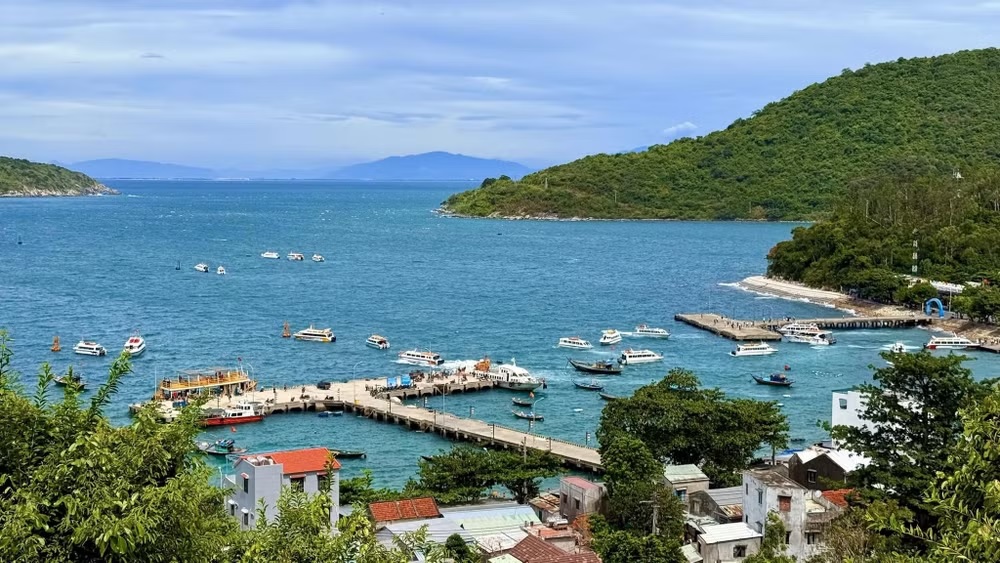
Cham Island of Tan Hiep commune, Da Nang city. (Photo: LE ANH QUAN)
Resolution No. 20-NQ/TW of the Third Plenum of the 14th Central Committee of the Communist Party of Vietnam on building and developing Vietnam into a strong marine nation was issued on July 28, 2026. To achieve the goals set forth in the resolution, energy infrastructure is considered to be crucial in the formation of economic centers, seaports, free trade zones, tourism services, and new marine economic sectors.
Experience shows that as the marine economic space expands, the demand for energy infrastructure also increases.
Electricity infrastructure goes hand in hand with marine economic zone
Resolution No. 20-NQ/TW identifies priorities for developing strategic, dual-use, digital, and energy infrastructure; strengthening connectivity between the mainland and islands, and between coastal dynamic regions and major economic centers; and simultaneously forming industrial, services, logistics, energy, and innovation centers linked to the advantages of each region.
The demands from the central region are being incorporated into the new development orientation, with the Central Power Corporation (EVNCPC) managing electricity sales in all seven coastal provinces and cities.
According to EVNCPC Deputy General Director Tran Nguyen Bao An, the requirement to both ensure power supply for existing loads and prepare infrastructure for new growth drivers of the marine economy is a challenge for the unit. One of the current challenges is the imbalance between power generation and demand.
According to the Power Development Plan VIII, by 2030, approximately 50,000MW of power generation capacity will be put into operation in the 7 provinces managed by EVNCPC, while the current load demand is about 5,000MW and is projected to reach about 10,000MW by 2030.
With a vast geographical area and unevenly distributed load, the power sector must also calculate reserve capacity to ensure safe and flexible system operation. Not only must the power infrastructure meet existing load demands, but it must also be prepared to accommodate new energy sources.
It was stated by Mr. Tran Nguyen Bao An that, along with new power sources, including offshore wind power under the revised Power Plan VIII, EVNCPC is ready to coordinate with investors, relevant agencies, and localities to promote the development of energy infrastructure, meet electricity demand, and support the development of the marine economy.
Therefore, ensuring power supply to the sea and islands is not only a production and business task but also has significance for socio-economic development, national defense, and security.
Investing in the synchronized development of power sources, grids, digital infrastructure, and new energy sources will contribute to creating a foundation for achieving the goals of Resolution No. 20-NQ/TW, gradually transforming the potential of the sea into a driving force for growth, aiming to build Vietnam into a strong marine nation, developing sustainably and prospering from the sea.
Translator: Nguyễn Thị Lan Anh
Share