During the meeting, EVN Vice President Nguyen Tai Anh noted that Vietnam faces the dual challenge of meeting rapidly growing electricity demand while gradually transitioning towards low-emission energy sources. As the share of renewable energy in the country's power generation mix is expected to continue increasing, the development of reliable and stable power generation sources, including nuclear power, will play an important role in safeguarding energy security and ensuring the sustainable development of the national power system.
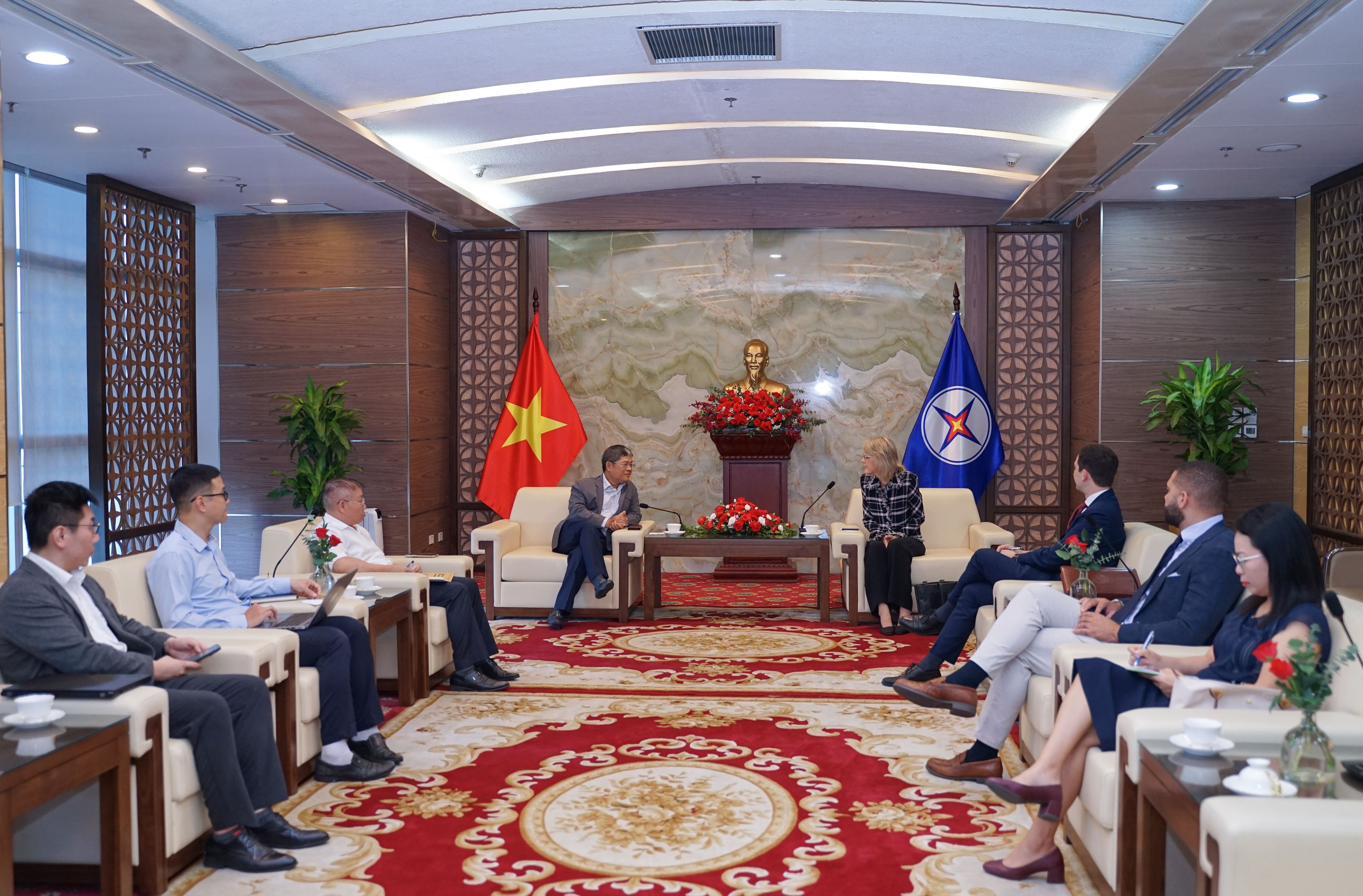
EVN Vice President Nguyen Tai Anh chairs meeting with U.S. Department of State delegation on morning of 21 October.
Vietnam is currently reviving its nuclear power development programme, with an initial focus on large-scale nuclear power projects. At the same time, small modular reactor (SMR) technology is also attracting growing interest due to its flexibility in terms of generating capacity and potential applications.
Representing the U.S. delegation, Ms. Kirsten Cutler introduced several international cooperation initiatives in the nuclear power sector, including a trilateral cooperation framework involving the United States, Japan, and the Republic of Korea. This framework aims to bring together the industrial capabilities, supply chains, and resources of the three countries to advance SMR technology development. The Indo-Pacific region was highlighted as one of the priority areas for promoting such cooperation.
The U.S. delegation also provided information on the Foundational Infrastructure for Responsible Use of Small Modular Reactor Technology (FIRST) programme, an initiative launched by the U.S. Department of State to help countries build the capabilities necessary for the safe and responsible development and deployment of SMR technology.
The programme focuses on key areas such as human resource development, infrastructure development, strengthening legal and regulatory frameworks, and enhancing nuclear safety management capabilities.
Regarding SMR technology, U.S. representatives shared information on several reactor designs currently under development and deployment worldwide, as well as their potential applications in supplying electricity to national power grids, industrial parks, and data centers.
Compared with conventional large-scale nuclear power plants, SMRs offer greater flexibility in generating capacity and investment arrangements. Their modular design allows for phased deployment, enabling projects to be tailored to electricity demand and specific local conditions.
At the conclusion of the meeting, the two sides expressed their interest in maintaining regular exchanges and sharing international experience in SMR technology, particularly regarding nuclear safety, economic viability, and practical deployment considerations.
These exchanges are expected to provide valuable insights and reference information to support further research and assessment of the potential application of SMR technology in Vietnam in the coming period.
Translator: Hoàng Duy Khánh
Share