Gradually reducing coal-fired thermal power
Vietnam's participation in the Global Declaration on the transition of coal-fired power to clean energy poses great pressure, because the need for economic development requires a very high demand for energy in the coming period. The GDP growth target in 2025 is 8% or more, and it is expected that the following years can reach double digits, causing manufacturing industries to need more power to expand operations. This entails an average increase of 12% to more than 16% in annual power output, according to calculations by the Ministry of Industry and Trade (MOIT).
The national power development plan for the 2021-2030 period, with a vision to 2050 (adjusted Power Plan VIII), was accomplished to develop a comprehensive energy industrial ecosystem based on renewable energy and new energy.
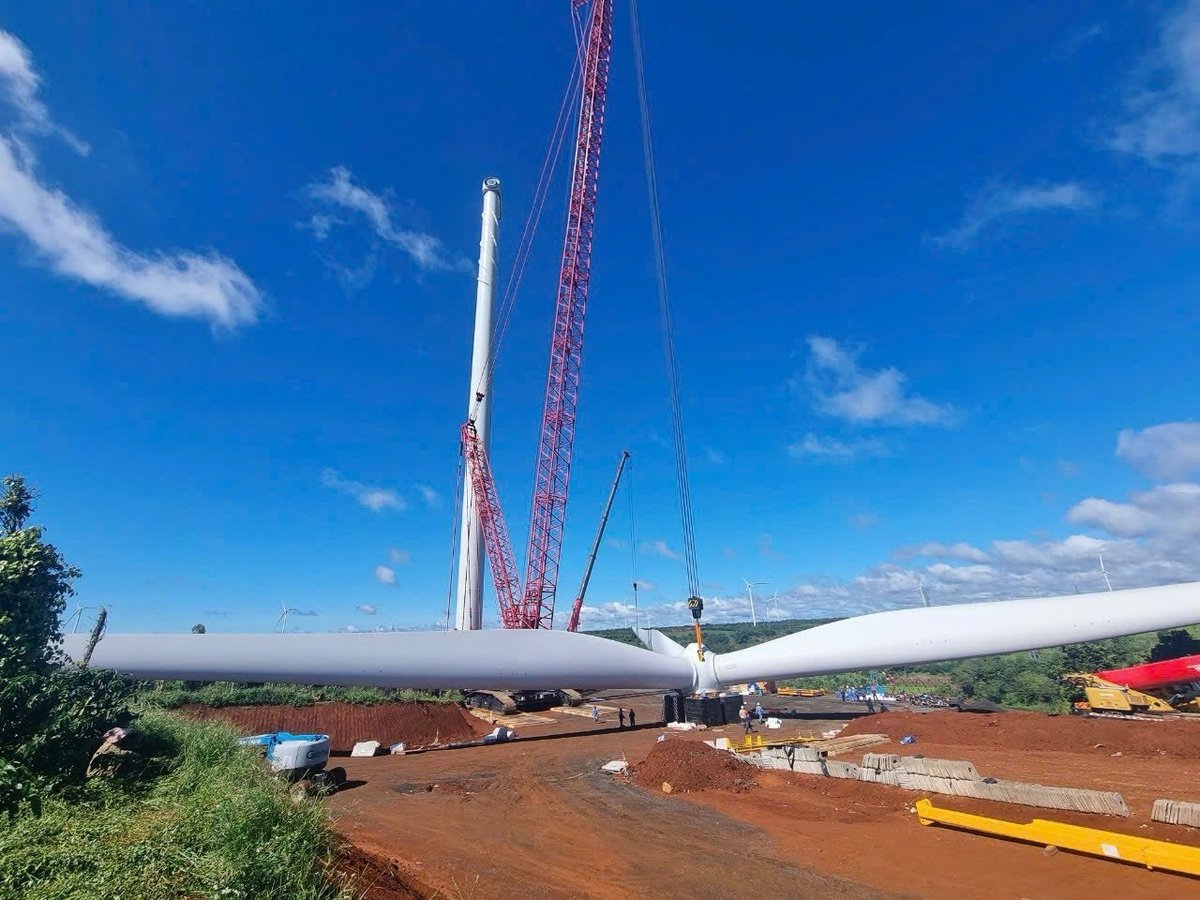
Construction site of wind power plant in Central Highlands. Photo: Tuan Anh.
Regarding coal power, the adjusted Power Plan VIII clearly states that only projects that are already in the plan and are being invested in construction will be continued until 2030; at the same time, it is oriented to convert fuel to biomass/ammonia for plants that have been in operation for 20 years when the cost is suitable. Plants with a lifespan of more than 40 years will be stopped if they cannot convert fuel.
In the power source structure by 2030, coal-fired thermal power capacity accounts for 13-17%, a sharp decrease compared to the rate of over 50% in the current power source structure. By 2050, Vietnam will not use coal for power generation. This is an important factor in achieving the national commitment to net zero emissions.
The above roadmap is closely linked to the development of power sources from renewable energy to offset the power capacity needed. The plan sets a target of increasing the proportion of renewable energy (excluding hydropower) in the power source structure to about 28-36% by 2030 and orients that by 2050, this proportion will reach an impressive level of 74-75%.
Suitable onshore and offshore wind power sources and solar power will be invested to the maximum with the absorption capacity of the national power system, the capacity to release the power grid, as well as reasonable transmission costs. In addition, the State also prioritizes and encourages the development of wind power and solar power for on-site consumption, without connection or sale of electricity to the national grid.
Opportunities to form renewable energy centers
To implement the Plan, MOIT also proposed to build 2 inter-regional renewable energy industrial and service centers. The Northern Center will be located in localities such as Hai Phong and Quang Ninh, with the possibility of expanding to neighboring areas in the future. This center will include factories manufacturing equipment and devices for wind and solar power, logistics services, specialized seaports to support the construction, operation, and maintenance of renewable energy projects. Similarly, the Southern Center is expected to be located in Ninh Thuan and Ho Chi Minh City.
Translator: Mạnh Hùng
Share