Solar power not only lights up remote islands, but also opens up a new way of life – greener, healthier, and stronger. From solar panels in the fishing villages of Phu Quy, Ly Son, or Nam Du, the story of renewable energy is now linked to protecting the environment and improving community health – a sustainable transformation from the very islands.
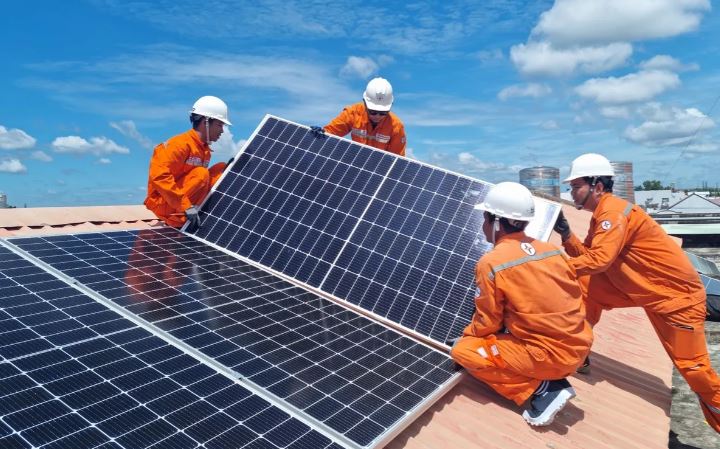
Sustainable transformation from sea and islands
When light comes to remote islands
Since 2020, cooperation programs between EVN, the Ministry of Agriculture and Environment, and international organizations such as JICA and UNDP have helped hundreds of coastal households access solar power systems combined with battery storage.
In recent years, from the sea of Binh Thuan (now Lam Dong province) to Quang Ngai, "green battery clusters" have sprung up in the middle of the islands, lighting up Vietnam's clean energy journey. In Phu Quy, a solar power project with a capacity of more than 800kWp and a 6MW wind power plant have come into operation, connected to the SCADA smart power management system. Thanks to that, people have significantly reduced their dependence on diesel generators, and electricity has become stable and eco-friendly.
Since 2023, when the solar power system with a capacity of more than 3MW came into operation, life on Phu Quy island has changed. Clean electricity helps fishermen preserve seafood in freezers, helps children study, and helps women do extra work of processing dried fish using solar energy. Many households have also invested in additional solar panels to sell surplus power to the island's general system. On Be An Binh Island, a 96kWp solar power system has supplied electricity 24/7 to hundreds of households - a turning point for a place that used to only have lights on for a few hours each night. In parallel, the "Non-Carbon Islands Innovation" project aims to turn Ly Son into the first "carbon-free" island, combining wind power, solar power, and energy storage. "Storm-proof" houses with solar roofs – financed and assisted by UNDP - are appearing along the sandbanks, a small but steadfast signal for the autonomous and sustainable future of coastal residents in Vietnam.
Not just energy – it’s a new way of life
The Ministry of Industry and Trade says renewable energy – especially solar and wind – will be key to helping Vietnam achieve its carbon neutrality target by 2050. In June 2025, the Government approved a plan to support 50 pilot “renewable energy fishing villages” in coastal provinces, prioritizing the Central and Southern regions.
Phu Quy, Con Dao, Nam Du, and Ly Son are four pioneering locations. The model goes beyond just providing power and also integrates “agri-aqua-solar”. Photovoltaic panels installed on fish ponds or salt fields both create shade and collect energy – “killing two birds with one stone”.
Translator: Mạnh Hùng
Share