This is an important activity in the preparation roadmap for the implementation of the Ninh Thuan Nuclear Power Project and similar projects in the future.
The INIR delegation included 7 IAEA experts, 3 international experts invited by the IAEA from the UK, Brazil, Bulgaria, and 01 observer from Egypt.
The delegation will work with representatives of relevant ministries, branches and units of Vietnam, including the Ministry of Industry and Trade, Ministry of Finance, Ministry of Public Security, Ministry of National Defense, Ministry of Foreign Affairs, Ministry of Agriculture and Environment, Ministry of Education and Training, Vietnam Electricity Group (EVN), Vietnam National Energy - Industry Group (PVN), and Khanh Hoa Provincial People's Committee.
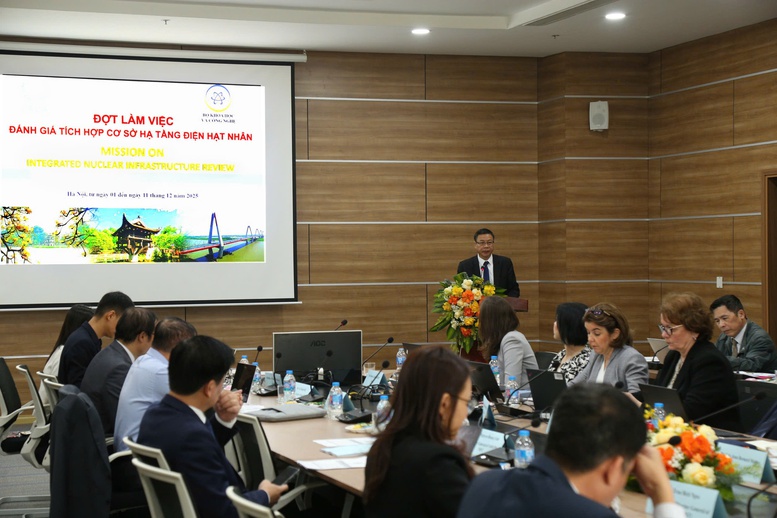
Deputy Minister of Science and Technology Le Xuan Dinh making speech at Working Session to assess integration of nuclear power infrastructure in Vietnam - Photo: baochinhphu.vn
Deputy Minister Le Xuan Dinh affirmed that MOST, as the coordinating and presiding agency for the development of nuclear power infrastructure, will promote nuclear power infrastructure development activities according to the recommendations of the IAEA to meet the requirements of the first nuclear power project in Vietnam. At the same time, MOST will continue to support and advocate cooperation activities between Vietnam and the IAEA in developing applications of atomic energy for peaceful purposes in Vietnam.
On the IAEA side, Mr. Eric Mathet, Head of the delegation, said that this delegation marked an important milestone in Vietnam's journey towards establishing a safe, secure, and sustainable nuclear power program, taking into account its safety obligations.
The IAEA highly appreciated the efforts of Viet Nam in preparing the Self-Assessment Report for this mission. The working group, comprising experts with extensive experience in the fields of nuclear power infrastructure, carefully studied Viet Nam’s Self-Assessment Report and maintained regular contact with the focal point of Viet Nam in reviewing and evaluating the report. The IAEA also encouraged open communication between the Viet Nam and INIR working groups to ensure the success of the working group.
According to IAEA guidelines, nuclear power infrastructure includes 19 main contents showing all activities and preparations in all aspects, from facilities, equipment, locations, auxiliary works, legal documents, to economic and human resources to serve the nuclear power development program.
For a country that is just starting its first nuclear power program, like Vietnam, the infrastructure development process must go through 3 stages marked by 3 corresponding milestones.
The respective phases and milestones are as follows: Phase 1 – Preparation for the decision to launch the nuclear power program, marked by Milestone 1 – Readiness for the decision to launch the first nuclear power project; Phase 2 – Preparation for the construction of the nuclear power plant, marked by Milestone 2 – Readiness for the first project tender; Phase 3 – Construction and commissioning of the first nuclear power plant, marked by Milestone 3 – Readiness for the first nuclear power plant.
This INIR Mission focused on reviewing and evaluating objectively and comprehensively all 19 nuclear power infrastructure contents compared to Milestone 2 according to IAEA guidelines.
In preparation for the Mission, the Working Group on assessing Vietnam's nuclear power infrastructure established by MOST has completed the Self-Assessment Report and sent it to the IAEA in October 2025.
Through the working session, the INIR delegation will have a summary report sent to the Vietnamese Government, which will point out the tasks that have been achieved, the areas that still need to be improved, and at the same time give important recommendations to support Vietnam in building a Master Plan for the development of nuclear power infrastructure, contributing to the implementation of the Ninh Thuan Nuclear Power Project to ensure progress, efficiency, safety, security, and meeting IAEA and international standards.
Translator: Mạnh Hùng
Share