Proactively develop operational plans in response to increased load demand.
The prolonged heatwave has led to a sharp increase in electricity demand. During the record-breaking heatwave at the end of May, the peak power capacity of the national electricity system on May 27th reached 58,103MW, a 15.4% increase compared to that of the same period in 2025; the North alone reached 29,966MW, a 27.5% increase. In the Central and Central Highlands regions, the peak power capacity reached 4,904MW, an 18.2% increase, and power consumption exceeded 102.6 million kWh/day for the first time.
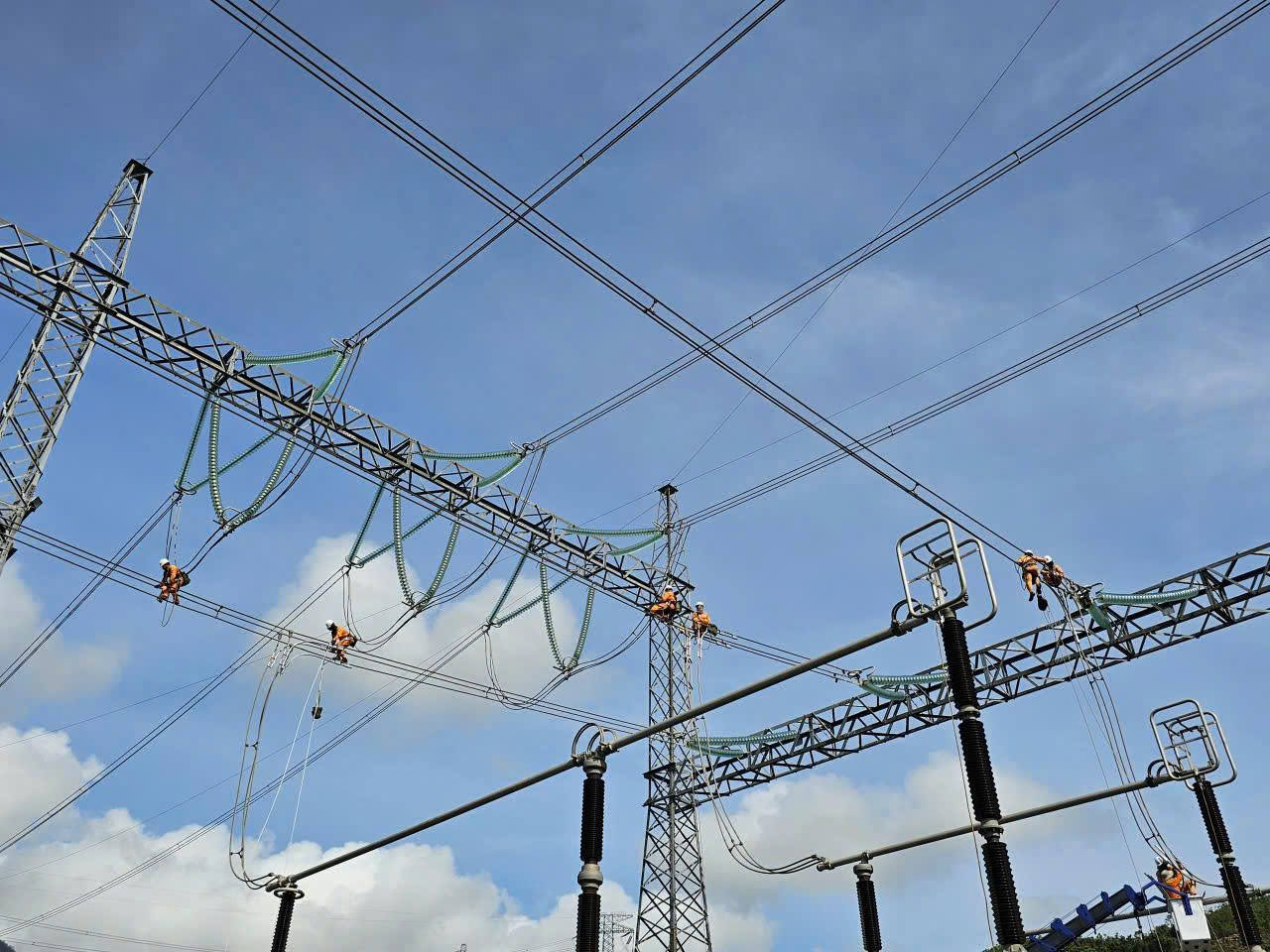
EVNNPT is repairing and reinforcing power grid ahead of this year's hot season. Photo: Le Linh
During the peak of the hot weather at the end of May 2026, the Central-North 500kV axis power grid transmitted a capacity of up to 5,019MW, reaching the limit calculated by the National Power System and Market Operator Company (NSMO), making a significant contribution to ensuring power supply for the North.
In anticipation of continued high electricity demand, EVNNPT has directed its units to strengthen inspections and reviews of the entire transmission grid, especially the four North-South 500kV transmission lines, and proactively develop appropriate operating plans.
Applying technology to enhance operational reliability
Over the years, EVNNPT has promoted the application of science and technology and digital transformation, bringing about significant efficiency in management and operation, especially in extreme weather conditions.
Unmanned aerial vehicles (UAVs), LiDAR technology, and AI-integrated cameras are widely used to monitor transmission line corridors, detect equipment anomalies early, and warn of forest fire risks and violations of power grid corridors.

EVNNPT workers on duty to manage operations during recent peak heatwave. Photo: Le Linh.
EVNNPT also effectively utilizes fault location systems, lightning monitoring systems, and software for managing power lines, substations, GIS, and CBM, helping to digitize technical data and accurately assess equipment status.
At PTC2, 100% of the 220kV substations have been converted to unmanned operation and centralized remote monitoring. The company has equipped the transformers and 500kV reactors with temperature sensors, an online oil monitoring system, DC ground fault monitoring, and built automated UAV flight paths to inspect and detect thermal emissions from equipment within the substation.
With a proactive approach and without complacency in the face of extreme weather events, EVNNPT is focusing all resources and preparing operational plans to ensure the safe and stable operation of the national power transmission system, contributing to meeting the electricity demand for socio-economic development and people's lives during the summer of 2026.
Translator: Nguyễn Thị Lan Anh
Share