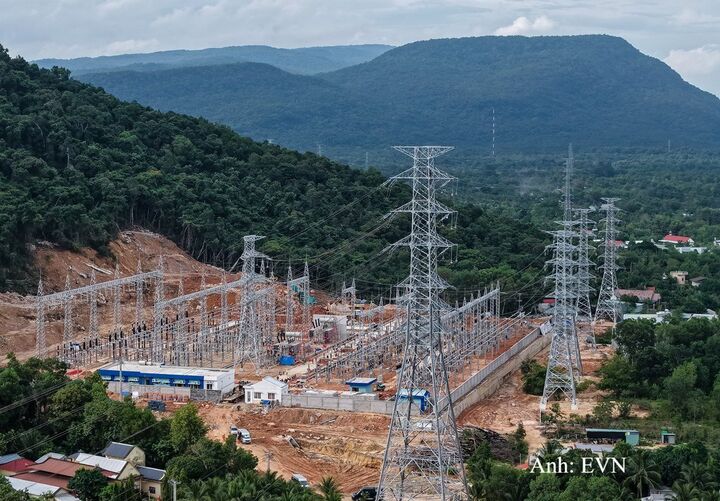
Overview of Phu Quoc 220kV substation
Electricity must be one step ahead in the new development space.
Resolution No. 20-NQ/TW dated July 28, 2026, of the Third Plenum of the 14th Central Committee of the Communist Party of Vietnam on building and developing Vietnam into a strong maritime nation, identifies the marine economy as an important growth driving force and sets out the requirement to expand development space to the open sea, deep sea, and new maritime spaces. The resolution sets a target that by 2030, the total GRDP of coastal provinces and cities will contribute over 70% of the national GDP, the average GRDP growth rate of coastal localities will strive to reach over 11% per year, 6-10GW of offshore wind power will be developed, and 5-6 strong maritime economic centers will be formed.
The situation in Central Vietnam shows that the power sector is gradually preparing for this requirement. According to the Power Development Plan VIII, by 2030, approximately 50,000MW of power generation capacity is expected to be put into operation in the 7 provinces managed by the Central Vietnam Power Corporation (EVNCPC), while current load demand is around 5,000MW and is projected to be around 10,000MW by 2030. The significant gap between power generation capacity and local load demands the need for synchronized grid development, balancing supply and demand in each region, and improving transmission capacity.
Notably, all seven provinces managed by EVNCPC have long coastlines, home to numerous aquaculture, tourism, service, industrial, and port activities. Hence, investing in the power grid in this region is not simply about meeting existing load demands, but also about considering new demands that will emerge as the marine economic space expands.
Not only is the power grid expanding, but the way it operates is also changing. Unmanned 110kV substations, remote control centers, and distribution grid automation are increasingly being put into use; Da Nang Power Company alone is operating 26 unmanned 110kV substations, while GIS technology is being applied at the Chi Lang 110kV substation to reduce land use, increase safety, and better suit the aesthetic requirements of the city.
These projects may differ in scale and technology, but they all demonstrate a significant shift in investment thinking: power infrastructure must not only meet existing load demands but also anticipate the needs of an emerging development space.
Looking at the electricity infrastructure challenge for the marine economy from the perspective of Phu Quoc.
In less than the last half of August 2026, three key power projects in Phu Quoc were successively put into operation: the 110kV Phu Quoc - South Phu Quoc transmission line, energized on August 16th; the Phu Quoc 220kV substation, completed on August 19th; and the Phu Quoc - North Phu Quoc 110kV transmission line, completed on August 28th. With a total investment of approximately VND 2,165 billion, these three projects not only serve the power supply requirements for APEC 2027 but also enhance infrastructure capacity for the long-term development of the special economic zone.
These projects have contributed to increasing the power supply capacity for Phu Quoc, especially the commissioning of the Phu Quoc 220kV substation, which facilitated the conversion of the operating voltage of the Kien Binh - Phu Quoc transmission line from 110kV to 220kV, thereby increasing the power supply capacity to 500MVA.
According to the Southern Power Corporation (EVNSPC), the Kien Binh - Phu Quoc transmission line is of "vital" importance to the Phu Quoc 220kV substation, because once the substation comes into operation, it will fully utilize the effectiveness of this transmission line. From the 220kV substation, the electricity demand for Phu Quoc's future development has been calculated with a vision to 2035.
Behind those technical specifications lies the expansive development potential for an island rapidly transforming from a tourist destination into an economic space with increasingly demanding infrastructure requirements. As power supply capacity increases, connectivity, redundancy, and system reliability improve, making electricity one of the foundations for Phu Quoc to accommodate further tourism, service, trade, and infrastructure projects serving major international events.
According to Mr. Nguyen Tai Anh, Vice President of Vietnam (EVN), in recent times, the units have focused resources on completing the power supply projects for Phu Quoc more than a year ahead of schedule, thereby providing more time to prepare and put the projects into reliable operation before APEC 2027. This result was achieved thanks to the efforts made by EVNSPC, contractors, consulting units, along with the support of the local government and the direction of the Government and the Ministry of Industry and Trade.
From EVN's perspective, Mr. Nguyen Tai Anh stated that ensuring power supply to the sea and islands is not only a business task but also a particularly important political task. EVN has invested in many projects to bring electricity to the sea and islands, contributing to socio-economic development and strengthening national defense and security; however, given the new development requirements, the need for resources for marine energy infrastructure will remain very high.
Therefore, implementing Resolution No. 20-NQ/TW for the electricity sector is not just about ensuring sufficient power for coastal localities, but also about planning power sources and grids in sync with seaports, free trade zones, industrial parks, logistics, tourism, urban areas, and new marine economic sectors. Wherever offshore power sources develop, the transmission infrastructure shall be prepared accordingly; wherever marine economic centers are formed, the power supply capacity, backup, and system control shall be calculated early on.
|
From the coastal power lines in Central Vietnam to the recently completed project in Phu Quoc, it is evident that the power sector is gradually transforming the demands of a new development space into concrete projects. Electricity is inherently a prerequisite infrastructure, but in the journey towards a strong maritime nation, the requirement of "leading the way" also carries another meaning: not only meeting current needs but also having the capacity to pave the way and create opportunities for new growth-driving forces, formed from the sea.
|
Translator: Nguyễn Thị Lan Anh
Share