Attendants at the meeting included EVN’s Board Member and President and CEO Nguyen Anh Tuan, EVN’s Board Member Dang Huy Cuong, EVN’s Vice Presidents Nguyen Tai Anh and Pham Le Phu; along with the Chairmen and General Directors of the power corporations, and leaders of the Power Project Management Board No.1 (EVNPMB1).
BESS – an inevitable trend
At the meeting, Board Member Dang Huy Cuong stated that by 2025, the total capacity of BESS invested globally is estimated to reach approximately 300,000MW. This scale demonstrates that BESS is becoming an inevitable trend in the global energy transition.
In Vietnam, as the proportion of renewable energy in the power generation mix increases, BESS will clearly demonstrate its effectiveness in improving the stability of the power system. Significantly, BESS contributes to peak load coverage, thereby reducing or partially replacing the need for investment in traditional peak-load power sources. At the same time, BESS can also support power supply and reduce the risk of overload during peak periods, and so on.
For EVN, from 2025, implementing the Ministry of Industry and Trade's directive in Notice No. 198/TB-BCT dated August 8, 2025, regarding the Minister's conclusions at the Conference on the situation and solutions to ensure power supply for the remaining months of 2025 and the years 2026-2030; to meet peak load demand and ensure power supply capacity in 2026 and subsequent years, the Group has assigned its general corporations and units to proactively implement procedures for investing in and installing battery storage on the power grid.
At the meeting, the Chairwoman of the Member Board of the Northern Power Corporation (EVNNPC), Do Nguyet Anh, stated that the Corporation had directed its units to review and survey 110kV substations capable of deploying energy storage systems. Initial calculations show that the total BESS capacity that can be installed at EVNNPC's units is approximately 530MW, with a storage time of 2 hours, equivalent to 1,060MWh.
EVNNPC has consulted and coordinated with National Power System and Market Operation Company Limited (NSMO) to determine the appropriate scale and purpose of implementation. In phase 1, the Corporation is implementing the initial investment steps for the BESS with a total capacity of 305MW, expected to be completed by the end of June 2026, while continuing to implement subsequent phases in the future.
For Hanoi Power Corporation (EVNHANOI), the unit assigned by the Group to develop BESS with a total capacity of 275MW, the corporation is currently implementing BESS with a total capacity of 50MW at 5 substations in the city during the pilot phase.
In the southern region, Mr. Nguyen Phuoc Duc - General Director of the Southern Power Corporation (EVNSPC) said that the corporation is working with relevant businesses to research and consider implementing BESS on Phu Quy Island. Putting BESS into operation on the island's power grid is expected to bring about significant economic benefits.
On the power transmission grid, the National Power Transmission Corporation is also accelerating the deployment, with the first 100MW of BESS expected to be installed at substations by January 2027.
At the meeting, Bui Phuong Nam, Director of EVNPMB1, reported that his corporation is assigned by the Group to study the feasibility of investing in BESS with a total projected scale of 300-500MW. EVNPMB1 has conducted surveys and initially identified four potential locations associated with several power sources in the North for consideration in subsequent phases.
Overcoming obstacles and accelerating BESS development
According to the revised Power Development Plan VIII, energy storage capacity will reach 10,000 - 16,300MW by 2030.
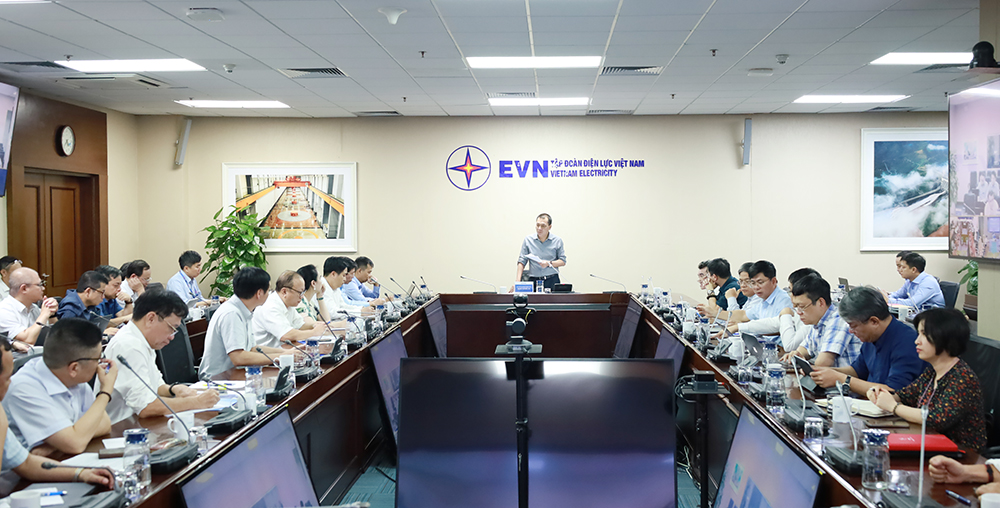
EVN’s Chairman Dang Hoang An presiding over meeting.
EVN’s Chairman of the Member Board Dang Hoang An emphasized that BESS is identified as one of the important solutions in the operation and development of the power system. One of the outstanding advantages of BESS is its rapid deployment and installation time. Although the investment cost is still relatively high, when considered in the overall context with traditional power sources, BESS is not necessarily less advantageous, especially when considering the values of flexibility and system operation efficiency.
EVN’s Chairman of the Member Board requested that BESS be viewed in its entirety, encompassing multiple roles and functions, not limited solely to the two objectives of peak load coverage and reduction of system overload. Units need to develop a systematic and synchronized BESS development roadmap with high determination in implementation, ensuring investment efficiency. In particular, for the Northern region, units should prioritize accelerating the deployment of BESS.
The selection of the location, scale, and type of BESS system needs to be calculated in stages, year by year, linked to the actual needs of the power system and specific technical requirements, serving as a basis for effective investment and implementation throughout the Group.
Translator: Nguyễn Thị Lan Anh
Share